How to Turn a Dissertation Into a Journal Article?
Turning a dissertation into a journal article is a valuable step for researchers who want to share their findings with a wider academic audience. A dissertation usually contains detailed background information, an extensive literature review, research methods, and multiple findings. A journal article, however, focuses on a specific research question and presents the most important results in a concise format.
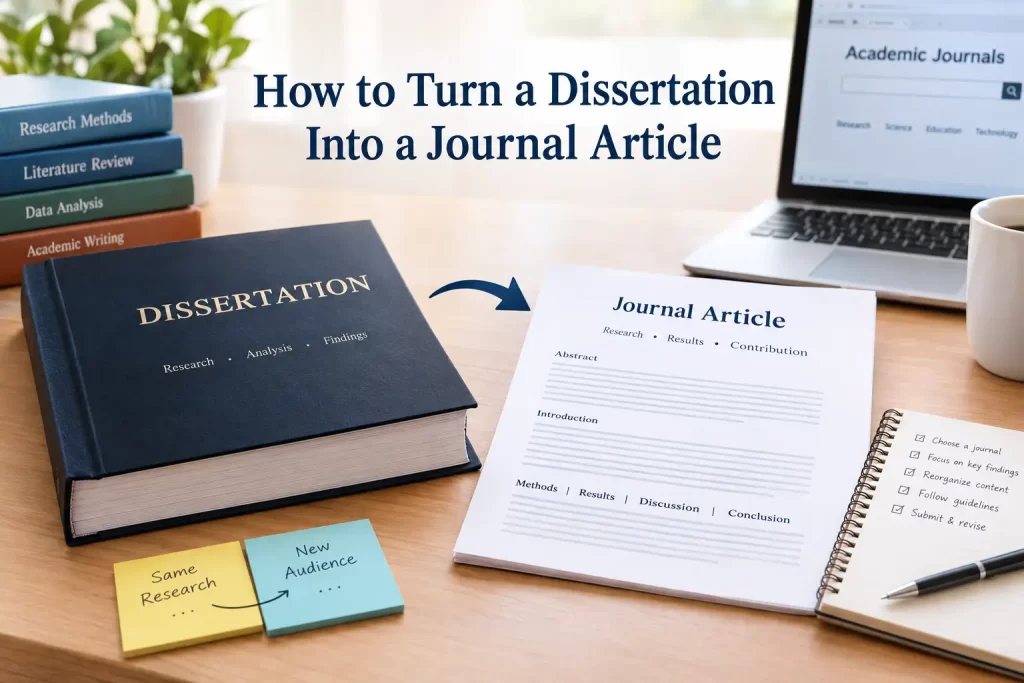
The process of converting a dissertation into a journal article requires more than reducing the word count. Researchers need to identify their strongest findings, select a suitable journal, reorganize the content, and follow the journal’s publication requirements. With careful planning, dissertation research can become a focused manuscript that contributes to ongoing academic discussions.
Shorten the Literature Review and Methodology
Dissertations often contain extensive literature reviews to demonstrate a researcher’s understanding of the subject. Journal articles usually require a more selective review of previous studies. Retain the research that establishes the problem, explains the knowledge gap, and provides context for your findings. Remove lengthy historical explanations and repeated descriptions unless they are necessary for understanding the study.
The methodology section also needs careful editing. Explain the research design, data sources, participants or materials, and analytical techniques clearly. Include enough detail for readers to evaluate the reliability of the research and understand how the findings were obtained. The aim is to make the manuscript concise without removing information essential to its academic quality.
Present Your Findings Clearly
Your findings should form the central part of the journal article. Select the results that directly answer the research question rather than including every result from the dissertation. Use tables, figures, or short explanations when they make complex information easier to understand. In the discussion section, explain what the findings mean and how they relate to previous research. Researchers should also describe the study’s limitations and avoid making claims that extend beyond the available evidence. A strong article does more than report results; it explains why those results matter to the field.
Rewrite the Title, Abstract, and Introduction
These sections help readers and journal editors understand the article’s purpose quickly. Write a specific title that reflects the central research question or finding. The abstract should briefly summarize the research problem, objective, methods, principal results, and contribution. Since journals often impose strict abstract word limits, remove background details that do not support the main message.
The introduction should establish the research problem, explain the gap in existing knowledge, and state what the article aims to contribute. Avoid repeating the dissertation’s full background chapter. It is often easier to finalize the abstract after completing the main manuscript.
Review Publication Ethics and Submission Requirements
Before submission, check whether your dissertation has already been published in a repository, included in a book, or used in another article. Many journals accept articles developed from dissertations, but their policies concerning thesis availability and overlapping publications can differ.
Follow the journal’s requirements for research ethics, participant consent, authorship, acknowledgements, and disclosures. Give appropriate credit to supervisors and collaborators according to their actual contributions and the journal’s authorship criteria. Also, avoid submitting the same manuscript to multiple journals simultaneously.
Edit and Prepare the Manuscript for Submission
Before submitting your article, compare the manuscript with the journal’s author guidelines. Check the word count, headings, references, tables, figures, and required submission documents. Read the manuscript for clarity, grammar, repetition, and logical flow. Asking a supervisor or experienced researcher to review the paper can help identify weaknesses you may have overlooked.
Prepare a cover letter explaining the article’s main contribution and why it fits the journal’s scope. If reviewers request revisions, respond to their comments carefully and explain the changes made.
Learning how to turn a dissertation into a journal article involves identifying a focused research contribution, choosing an appropriate journal, restructuring the content, and presenting the findings clearly. Researchers should prioritize the quality and relevance of the manuscript rather than trying to include every detail from their dissertation.
A well-prepared article can make dissertation research more accessible to the academic community and create opportunities for further discussion and collaboration. By following journal guidelines, maintaining publication ethics, and revising the manuscript thoughtfully, researchers can prepare their work for a more effective journal submission.
Also Read